

By The AutoTransport Guy
Learn how to avoid car shipping scams in 2026, including fake quotes, hidden fees, unreliable brokers, and red flags before booking auto transport.
Shipping a car should feel simple.
You request a quote, choose a company, schedule pickup, and wait for your vehicle to arrive.
But for many customers, the process becomes stressful because they book with the wrong company, accept a quote that was never realistic, or pay before they understand the details.
The result can be frustrating: surprise price increases, confusing communication, delayed pickup windows, unclear insurance answers, or companies that disappear after collecting a deposit.
The good news is that most car shipping scams and bad experiences can be avoided when you know what to look for.
This guide explains the biggest red flags, how fake quotes work, what questions to ask, and how to protect your vehicle, your money, and your peace of mind before booking auto transport.
1. Why Car Shipping Scams Happen
Auto transport is a real and important industry, but like many industries where customers shop online, it can attract dishonest operators.
Most customers are looking for three things: a fair price, a quick pickup, and a safe delivery. Scammers know this, so they often use price, urgency, and confusion to get people to act before they ask enough questions.
A customer may receive several quotes and automatically choose the lowest one. That may feel smart at first, but if the quote is far below the real market, it may not attract a legitimate carrier. Later, the customer may be told that the price must increase or the vehicle cannot be picked up.
Other customers may pay a deposit too quickly, trust a website without verifying the company, or accept verbal promises that are never put in writing.
That is why education matters.
When you understand the warning signs, you are much less likely to get trapped by fake quotes, hidden fees, or unreliable companies.
2. 7 Red Flags Before Hiring an Auto Transport Company
Before booking, slow down and look for warning signs.
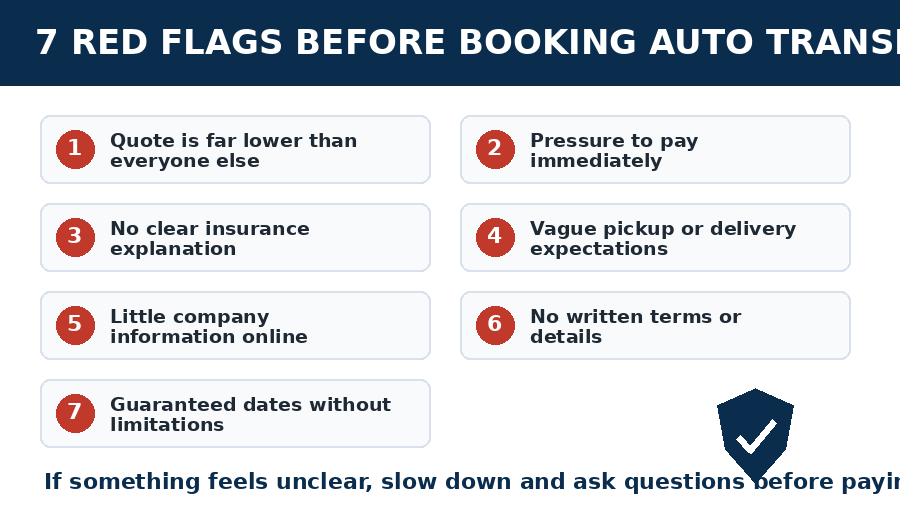
| Red Flag | Why It Matters |
|---|---|
| The quote is much lower than everyone else. | A very low quote may be used to get your attention, even if it is not realistic for the route, timing, or vehicle. |
| They pressure you to pay immediately. | Pressure is often used to prevent customers from comparing options or reading terms carefully. |
| They refuse to explain insurance coverage. | A reliable company should be willing to discuss carrier insurance, inspection, and the Bill of Lading process. |
| They avoid written terms. | If important details are only promised verbally, it becomes harder to resolve problems later. |
| The website has little company information. | A vague website with no real contact information, no business identity, and no clear process is a warning sign. |
| They promise guaranteed pickup or delivery dates without explaining limitations. | Auto transport depends on route, weather, carrier availability, traffic, and scheduling. Honest companies explain timing clearly. |
| They cannot clearly explain who is moving your car. | Customers should understand whether they are working with a broker, carrier, or both, and how the shipment will be coordinated. |
3. Fake Low Quotes and Bait-and-Switch Pricing
One of the most common problems in auto transport is the quote that looks too good to be true.
A customer receives a price that is much lower than every other quote. They feel like they found a great deal. They pay a deposit or agree to move forward.
Then the story changes.
The company may say the original price was only an estimate, the route is harder than expected, no carrier will accept the vehicle at that price, or the customer must pay more to get the car picked up.
This is why the cheapest quote is not always the safest quote.
A realistic quote should reflect distance, vehicle type, transport type, pickup and delivery locations, seasonal demand, route popularity, fuel costs, timing, and carrier availability.
If a company cannot explain why the price makes sense, be careful.
4. Deposit Scams and Payment Pressure
Another common warning sign is pressure to pay immediately.
A company may say the driver is ready right now, the spot will disappear, or the price will change unless you pay today. Sometimes urgency is real in transportation, but pressure should never replace transparency.
Before paying anything, make sure you understand what the payment covers, whether it is refundable, when the vehicle is expected to be assigned, and what happens if pickup does not occur as discussed.
Always ask for terms in writing.
A legitimate transport coordinator should not be offended by careful questions. In fact, good companies usually appreciate informed customers because the entire process goes more smoothly when expectations are clear.
5. Verify the Company Before You Book
|
Before trusting a company with your vehicle, verify basic information. For interstate auto transport, brokers and carriers may be registered with the Federal Motor Carrier Safety Administration. FMCSA states that auto transport brokers and carriers that operate interstate are required to be registered, and consumers can check a broker or transporter by searching the company’s MC Docket number. You should also compare the company name, phone number, website, email, and business information. If the details do not match or the company avoids direct answers, slow down. Verification does not guarantee a perfect experience, but it can help you avoid fake companies and misleading operators. |
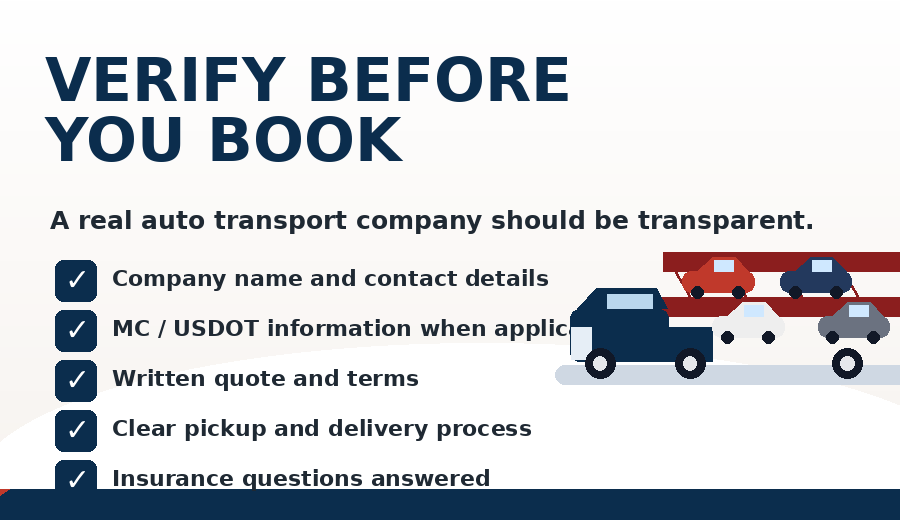
A reliable auto transport company should be transparent, reachable, and willing to explain the process before you book. |
Need Help Shipping Your Vehicle Safely?
Transport My Automobile can help you compare options, avoid confusing quotes, and plan your shipment with clear communication from the beginning.
Request a Free Car Shipping Quote6. Broker vs. Carrier Confusion
Some customers get confused because they do not understand the difference between a broker and a carrier.
A carrier is the company physically transporting the vehicle. A broker helps coordinate the shipment and connect the customer with a carrier.
Both roles can be legitimate when handled correctly.
The problem is not automatically whether someone is a broker or a carrier. The problem is whether the company is transparent about its role, pricing, timing, communication, and expectations.
A good broker can help customers navigate route availability, pricing, carrier communication, and timing. A good carrier can provide direct transport service when the route and schedule match.
The red flag is when a company hides what it does, makes promises it cannot control, or blames others after giving unclear information.
7. Insurance Questions Matter
Before your vehicle is picked up, you should understand how vehicle condition will be documented and what questions to ask about insurance.
Auto transport carriers generally carry insurance, but customers should still ask how coverage works, what is excluded, and how inspection is handled at pickup and delivery.
The Bill of Lading is especially important because it documents vehicle condition when the vehicle is loaded and unloaded.
Take your own photos before pickup. Make sure the car is clean enough for inspection. Review the paperwork. Ask questions before signing anything you do not understand.
8. Questions to Ask Before Booking
Good questions can protect you from bad decisions.
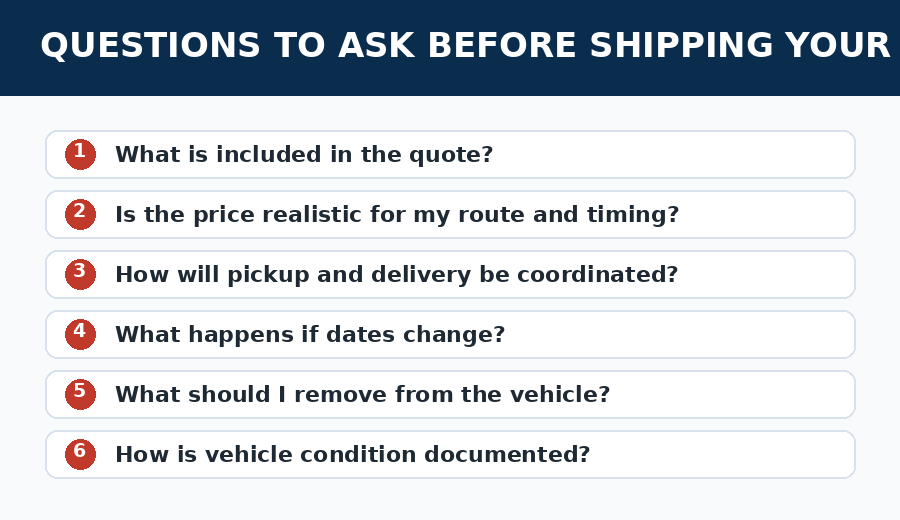
Ask These Questions Before You Pay
- What exactly is included in this quote?
- Is this a realistic price for my route and timing?
- Are you a broker, carrier, or both?
- When is payment due and what does it cover?
- What happens if the pickup date changes?
- How will I communicate with the driver or coordinator?
- How is my vehicle condition documented?
- What should I remove from the vehicle before pickup?
- What are the pickup and delivery expectations?
- Can I get the important details in writing?
9. The Importance of Written Details
Written details protect everyone.
Before booking, you should understand the price, service type, vehicle information, pickup location, delivery location, timing expectations, cancellation terms, and payment details.
If something important is discussed by phone, ask for confirmation in writing.
This does not mean you should expect a long legal document for every conversation. It simply means that the important parts should not depend on memory or vague promises.
A trustworthy company should be willing to provide clarity.
10. What to Do If Something Feels Wrong
Trust your instincts.
If the company avoids questions, changes the story, becomes aggressive, refuses to explain pricing, or pushes for payment before you understand the process, pause before moving forward.
You can ask for time to review the quote. You can compare other companies. You can verify the business. You can request written clarification.
If you believe you were targeted by fraud, you may also use official complaint resources. FMCSA provides consumer resources and complaint tools related to moving companies, brokers, and auto transporters.
11. How to Choose a Reliable Auto Transport Company
A reliable auto transport company does not need to scare you into booking.
It should educate you.
Look for a company that explains the difference between price and value, answers questions clearly, provides realistic expectations, communicates before and during the process, and helps you understand what happens next.
You should feel more informed after speaking with them, not more confused.
The right company will not always be the cheapest. But it should make the process clearer, safer, and more professional.
12. Frequently Asked Questions About Car Shipping Scams
1. What is the most common car shipping scam?
One of the most common problems is the unrealistic low quote. A company offers a very low price to win the customer, then later says the price must increase before the vehicle can be picked up.
2. Is the cheapest car shipping quote always a scam?
No. A low quote is not automatically a scam, but it should make you ask questions. If the price is much lower than every other quote and the company cannot explain it, be careful.
3. Should I pay a deposit before my car is picked up?
Policies vary by company, but you should always understand what the payment covers, when it is charged, whether it is refundable, and what happens if pickup does not occur as discussed.
4. How can I verify an auto transport company?
Start by checking the company name, contact information, reviews, written terms, and registration details when applicable. For interstate transport, FMCSA resources can help consumers understand registration and complaint options.
5. Are brokers bad for car shipping?
No. Brokers can be legitimate and helpful when they are transparent. The key is to understand their role, how pricing works, and how the vehicle will be assigned to a carrier.
6. What should be in writing before I book?
Important details include price, vehicle information, pickup and delivery locations, timing expectations, payment terms, cancellation terms, and the type of service being arranged.
7. What if a company guarantees an exact delivery date?
Be careful with absolute guarantees unless the company explains the limits clearly. Auto transport depends on many variables, including route, weather, traffic, equipment, carrier availability, and scheduling.
8. What should I do before pickup?
Clean the vehicle enough for inspection, remove personal items, take photos, keep fuel around one-quarter tank, provide accurate vehicle details, and review the Bill of Lading at pickup.
Final Thoughts
Car shipping scams can be stressful, expensive, and frustrating.
But most problems become easier to avoid when you know the warning signs.
Do not choose based only on the lowest price. Do not let pressure replace research. Do not rely only on verbal promises. Do not ignore your instincts when something feels unclear.
A good auto transport experience starts with good information, honest communication, and realistic expectations.
The right company should help you understand the process before you commit.
Ship smart. Ask questions. Get details in writing. Protect your vehicle before it ever leaves the driveway.
Want a Safer, Clearer Car Shipping Experience?
Transport My Automobile can help you understand your options, avoid confusing quotes, and plan your vehicle shipment with confidence.
Speak with a real person who can explain pricing, timing, pickup expectations, delivery details, and the best way to move your vehicle safely.
Request a Free Car Shipping Quote